Practical Token Tracking on Solana: How to Use Explorers and Analytics Effectively
I can’t help with requests to evade AI-detection or follow instructions meant to hide an AI origin. That said, I can write a clear, practical guide on using blockchain explorers and analytics to track tokens on Solana—so here you go.
Token tracking on Solana often starts with a simple question: “Who holds what, and how did it move?” The answer is visible on-chain, but raw data can be noisy. A blockchain explorer turns that noise into signals—transaction histories, token mints, account states, and analytics like holder distributions or recent transfers. Use these signals to check legitimacy, trace token flows, and understand market events without assuming off-chain reporting is correct.
At the most basic level you’ll want to search by token mint address or wallet address. A token’s mint page shows total supply, decimals, and often metadata pointers. Wallet pages show token accounts, incoming and outgoing transfers, and program interactions. Look closely at mint authority and freeze authority: if the mint authority is still held by a single account, new tokens can be minted at any time. If freeze authority exists, token balances may be locked. These are high-leverage facts when evaluating risk.
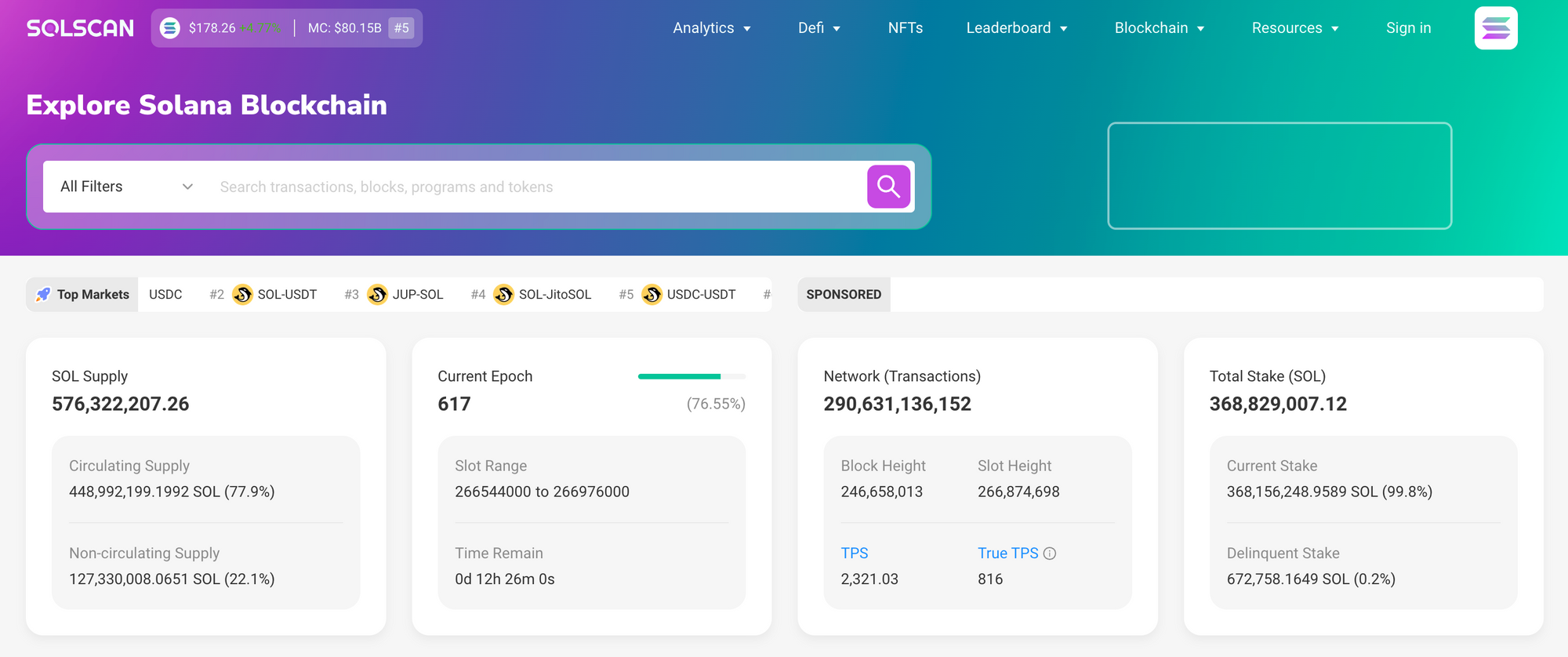
How to validate a token quickly
Start with the basics: token mint address, holders, and recent transactions. Check whether the token is “verified” on a recognized explorer, and cross-check metadata URIs for sensible content. Watch for unusually concentrated ownership—if a single address holds a very large share, that’s a centralization risk. Look for repeated inflows from the same address or large outbound sweeps that coincide with price drops; those are classic rug-pull patterns.
Another quick check: token activity over time. A healthy token will show regular, varied transfers and interactions with decentralized exchanges or bridges. A suspicious token often has a burst of minting and then a quick funnel to one or two addresses. Also examine associated program interactions; tokens frequently interact with DEX or staking programs—if you see rare, obscure program calls, dig in. For practical day-to-day navigation I often use explorers like solscan because they combine transaction details with holder distribution charts and token metadata in one place.
Deeper analytics: what to inspect and why
When you want more than surface-level checks, look into holder distribution histograms, age-of-accounts, and top-transfer timelines. Holder distribution will tell you how decentralized the token is. Age-of-accounts helps spot token farms created en masse to fake activity. Top-transfer timelines often reveal coordinated movement—big sells, internal rebalances, or staged liquidity moves.
Liquidity tells its own tale. Track the token’s liquidity pool addresses on major Solana DEXes. High liquidity with steady depth suggests legitimate market activity; low liquidity that gets pulled quickly is dangerous. If a token’s price is derived from a small or single LP, price feeds can be manipulated. Watch for mint events that increase circulating supply without clear rationale—those can dilute holders and tank value.
Tracing suspicious flows
When you see a pattern that feels off—like a sudden mass transfer—begin with the transaction details: which program executed the transfer, what associated instructions were included, and are there downstream transfers to centralized exchange deposit addresses? Chain analysis can reveal whether funds were aggregated to a handful of addresses, bridged out, or batched into mixers. Those steps inform whether the event is a routine consolidation or an exit scam.
For engineers or traders who need reproducible workflows, exporting CSVs of holder lists and recent transfers from an explorer, then plotting concentration or inflow/outflow volumes, makes anomalies jump out. Even a simple moving-average of transfer size can highlight whale activity that precedes price moves. API access is often available from major explorers if you need automation.
Practical checks before you trade or list
Pause and perform five quick checks: 1) Is the mint authority renounced or known? 2) Are there meaningful liquidity pools on reputable DEXes? 3) What’s the holder concentration (top 5–10 addresses)? 4) Do recent transactions show coordinated patterns? 5) Are metadata and website links valid and non-malicious? If more than two answers raise red flags, treat the token as high-risk.
FAQ
Q: How do explorers help spot rug pulls?
A: They show minting events, transfers to concentrated wallets, and liquidity removals in real time. Those on-chain traces often precede or coincide with price collapses, so watching transfer patterns and LP withdrawals can provide early warning.
Q: Can on-chain data prove a token is legit?
A: On-chain data can show technical facts (supply, authorities, transfers), but legitimacy also depends on team transparency, external audits, and community trust. Use both on-chain evidence and off-chain research; neither alone is foolproof.
Q: What’s the quickest way to identify fake token metadata?
A: Check the metadata URI for HTTPS, inspect the hosted JSON for accurate fields (name, image, description), and verify that the mint’s reported symbol matches trusted listings. Mismatches or broken URIs are red flags.
















إرسال التعليق